Main

Friday, May 16, 2008

Global Warming - It's Real, And We're Causing It

Global WarmingI was with a group of people yesterday, and one of them brought up the recent news of the U.S. listing polar bears as a threatened species under the Endangered Species Act, due to their expected decline as global warming melts the arctic sea ice they depend upon for survival. And of course, this got the conversation going on global warming. Out of the six of us, one guy thought that scientists just didn't know what the hell was going on with the climate, that there wasn't any real consensus on global warming at all, and that even if global warming were real, which he doubted, polar bears would find a way to survive, anyway. Another guy seemed more open to the idea that global warming could be happening, and could be human caused, but wasn't entirely convinced. I tried my best to defend the science, while the other three people stayed pretty quiet on the subject (although from a previous conversation, I think that one of them at least accepts that global warming is happening). Later on, when I told another guy about this conversation, he seemed to think that the current global warming might just be a natual cycle, and that it's not human caused. So, out of 7 people, I was the only one to strongly accept that current global warming is human caused.

Now, I'll admit I'm no expert on global climate. Not only am I not involved with the field at all, but I haven't really studied it in depth on a lay level, either, like I have other fields such as evolution. So, I guess I need to ask myself, how can I go on accepting that humans are causing global warming, and that it is a major problem?

First, I'll defer to the experts. I realize this isn't exactly a sound logical approach - after all, evidence is evidence no matter who discovers it. But, in the same way that I'll take my doctor's advice on what effects different medicines and procedures have, I'll put a fair amount of weight on the statements of the people who devote their careers to studying climate.

Continue reading "Global Warming - It's Real, And We're Causing It" »

Friday, March 28, 2008

A (Somewhat) Brief Introduction to Evolution

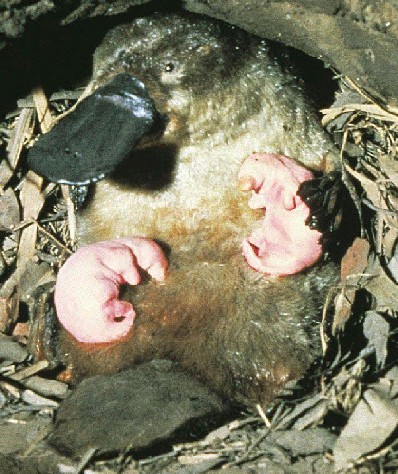
Evolutionary TreeThe other night, we went out to eat with some friends. I forget why, but for whatever reason my daughter was going through, with our help, trying to think up a mammal for every letter of the alphabet (aardvark, bear, cat...) Well, for P she picked platypus, so when the game was all over, it got us to talking about them. And I foget exactly how the next part came up, but the guy I was talking to brought up that he couldn't see how they were related to other mammals, and that he really doubted the whole theory of evolution. I tell ya what - get a couple beers in me and then tell me you don't accept evolution, and just see what type of conversation gets going. Boy, was it fun. Unfortunately, I don't think I did much convincing. It had nothing to do with the beer, but a whole lot to do with the fact that discussions like that are basically my word vs. your word. Considering that I'm not a biologist or in any related field, and it makes my word worth that much less. So, I decided to write up an e-mail to send him, along with links to lots of sources backing it up. Once I got through with typing it, I figured that it made for a decent general introduction to evolution. Maybe at some point I'll clean it up and make a good essay out of it, but even in its rough e-mail form, I figure it makes for a decent blog entry. So, if you want to read it, go head below the fold.

Continue reading "A (Somewhat) Brief Introduction to Evolution" »

Friday, March 07, 2008

Book Review - At the Water's Edge

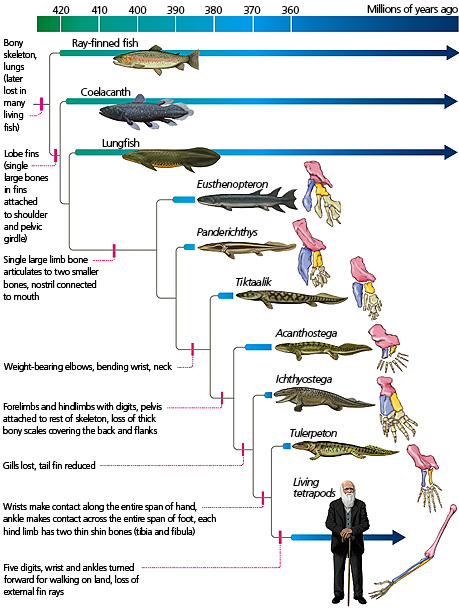
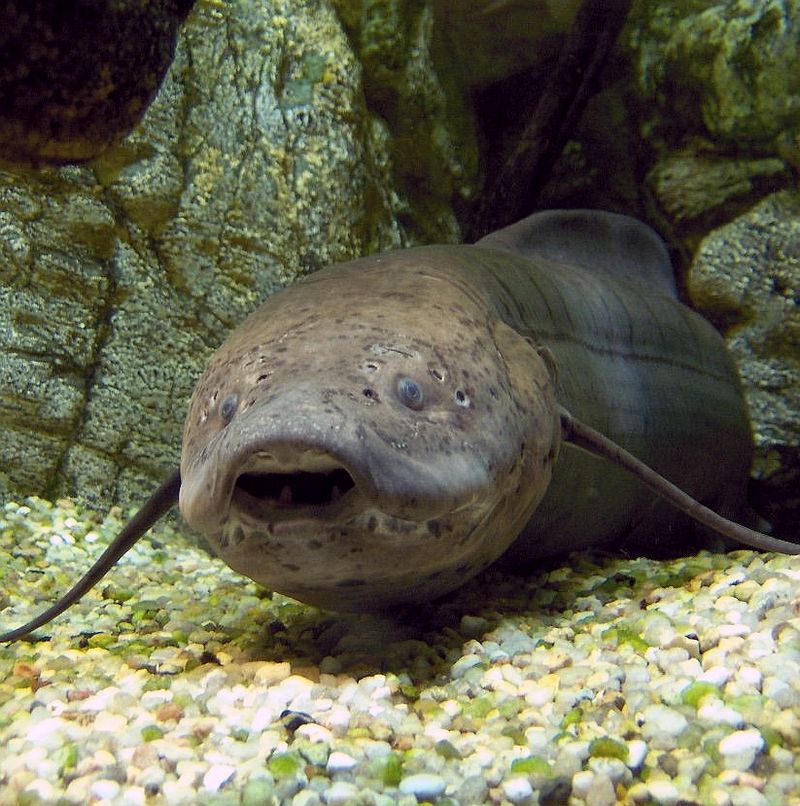
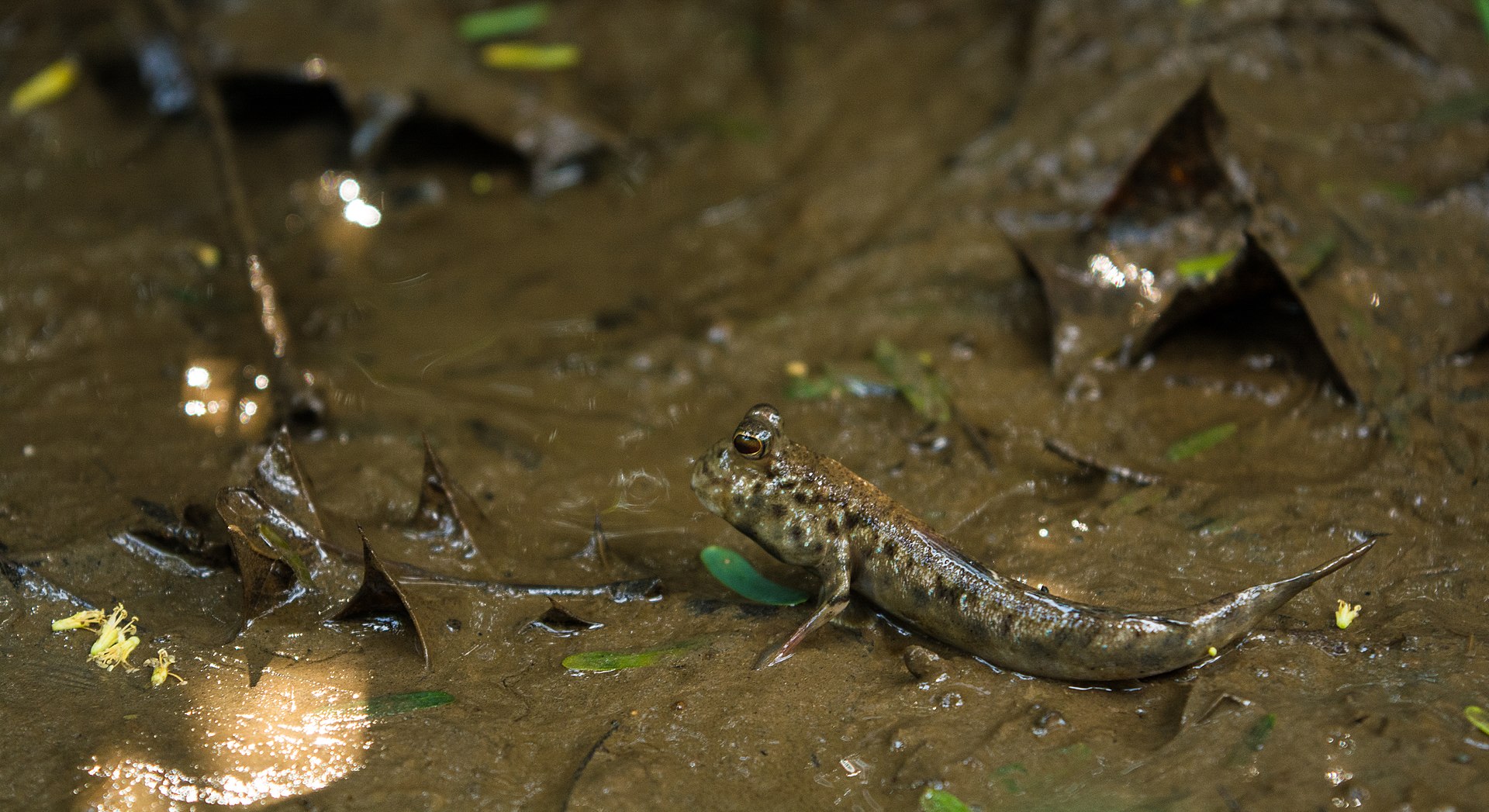
The full title of this book is At the Water's Edge : Fish with Fingers, Whales with Legs, and How Life Came Ashore but Then Went Back to Sea. It was written by Carl Zimmer, and as the long title suggests, is all about those two dramatic transitions of life evolving into such distinct environments. This book was great - one of the best non-fiction books I've read in a while. It was just the right blend of story telling, concepts, and evidence, and made for a very compelling read. In fact, I think I finished it in less than a week.

When I reviewed another book by Zimmer, the Smithsonian Intimate Guide to Human Origins, I commented that it wasn't very in depth. At only 176 pages, much of them filled with photos and illustrations, it was a little light on commentary. At the Water's Edge is very different in this regard. It's 304 pages, filled with small print, with only enough diagrams as are needed to illustrate a few key points. It's not a tome, by any means, but it certainly provides Zimmer with enough space to do this subject justice.

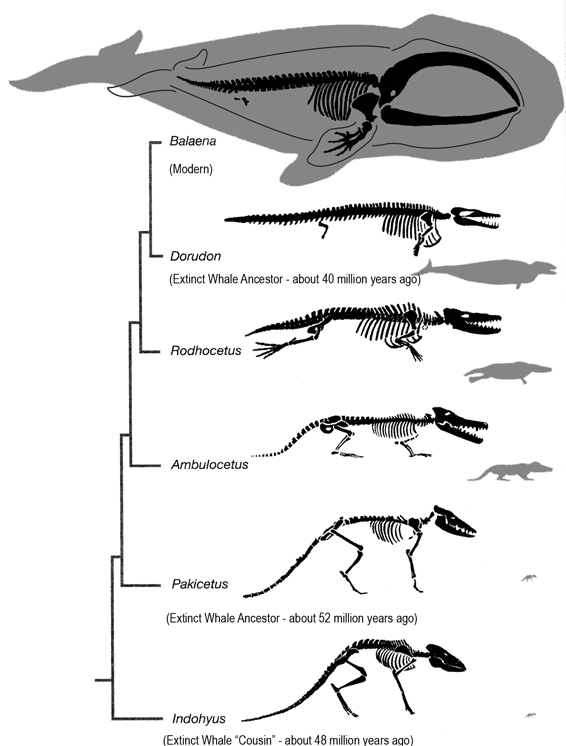
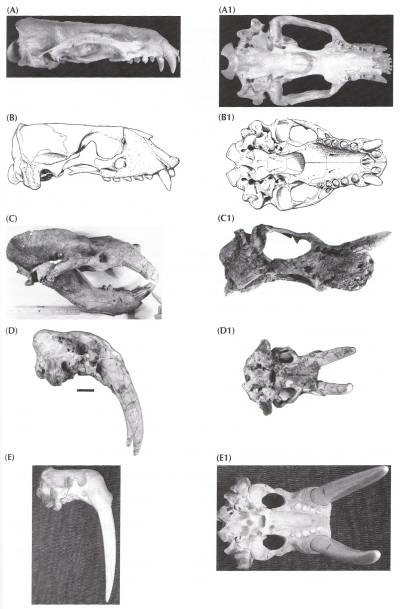
The book is divided into basically two halves - the first dealing with the transition from lobe finned fish to early tetrapods, and the second half dealing with the transition from mesonychids to dolphins and whales. As would be expected, both halves deal with the specifics of each of those cases - transitional forms that have been discovered, environmental pressures that would drive the transition, etc. However, mixed throughout the entire book are also sections on general theory. There's a nice section on development in the beginning, covering such topics as Hox genes and non-genetic factors; he describes exaptation; there's another section on cladistics; as well as sections on many other concepts related to evolution.

I learned quite a bit by reading this book. Even though I was already familiar with much of the general theory, Zimmer presented it in ways that made me think of things differently. He also introduced a few concepts, such as the evolutionary "quit point," that I hadn't thought of much before. Still, where I learned the most was in those specifics of the transitional forms between fish and tetrapods, and land mammals and whales.

I'll give one example of something very interesting I learned from this book. (In fact, this was the very first passage of the book that I read, when I first got it and was just thumbing through to see what it was like.) At some point, our ancestors must have developed lungs to breathe air, obviously. When we look at the world around us, most fish today cannot breathe atmospheric air - they rely on their gills to get oxygen from water, but also have organs similar to lungs called swim bladders, which they use to regulate their buoyancy. From that observation, you may be tempted to think that lungs are a modified swim bladder, which perhaps evolved to allow fish to survive in swamps or other oxygen poor environments. After all, what need would an ocean going fish have of lungs? I know that's what I had thought, but as it turns out, it's almost certainly wrong.

Continue reading "Book Review - At the Water's Edge" »

Friday, February 22, 2008

Book Review - Smithsonian Intimate Guide to Human Origins

I already posted a brief review of this book in my review of the Lucy's Legacy Exhibit at the Houston Museum of Natural Science. I don't really have much to add, but I thought I ought to at least give that review some closure, since I'd only read 2/3 of the book when I wrote it. I also figured this would give me a good chance to get the review into my Books section.

The book is the Smithsonian Intimate Guide to Human Origins, by Carl Zimmer. I liked it. It's not very in depth - it only took me about one weekend to read the whole thing - so if you follow science news, you probably won't learn a whole lot from it. That's not to say you won't learn anything - I certainly did learn a few things from this book, but most of the information was a review of what I alread knew.

But, it does have lots of pretty pictures that make it worth the price. And I mean that in the best possible way - paragraphs are all well and good, and it would be impossible to teach evolution with nothing but glossy pictures, but it can be nice to have a page full of pictures of fossil skulls, to see with your own eyes the similarities and differences. Sometimes pictures do show things more clearly than words ever could. Plus, if you don't follow science news as much as I do, or happen to know a person who doesn't know much about human evolution, it makes for a very good overview. If someone doesn't want to read the whole thing, but they're willing to listen to you explain something to them, you can still use the book, and open it up to some of those pretty pictures to help illustrate your point.

Tuesday, February 12, 2008

Book Review - Voyage of the Beagle

In honor of Darwin Day, I figured I'd post a review of The Voyage of the Beagle, which I just recently finished reading. The edition I read was actually the one from The Folio Society, given to me as a gift, and not the one pictured at right from Amazon. The book is also available as a free download from Project Gutenberg as a text only version, or as html with pictures, or from The Complete Works of Charles Darwin Online.

There are many reasons to like this book. One can't ignore the historical importance, since this expedition gave Darwin much of the insight that would lead to developing the theory of evolution, but this book would still be interesting even if Darwin had gone on to do nothing after sailing on the Beagle. The book is basically the journal of a young man on a round the world voyage, visiting much of South America, Tahiti, Australia, and a few other places, describing all the different cultures, geographies, and animals that he encountered.

For this review, I'll quote heavily from The Voyage of the Beagle, letting Darwin speak for himself, to give the reader a better idea of the language of the book. But first, let's get the somewhat confusing background out of the way. Darwin went along on the second survey expedition of the HMS Beagle. The first expedition, begun in 1826, consisted of two ships, the larger HMS Adventure, captained by Phillip Parker King, and the smaller HMS Beagle, captained by Pringle Stokes. Stokes committed suicide near the end of the first expedition, and 23 year old Flag Lieutenant Robert FitzRoy was named as temporary captain of the Beagle. On the second expedition, begun in 1831, only the Beagle returned, and as FitzRoy had proven himself well enough as temporary captain on the first expedition, he was given command of the ship for this second expedition. Worried about becoming depressed and suffering the same fate as Stokes, FitzRoy invited Darwin along for the journey so that he could have someone to talk to. As survey expeditions, the main purpose was acquiring data to produce nautical charts. Darwin had a slightly different agenda, as a naturalist, collecting many samples of the flora & fauna and taking many notes along the way. After the expeditions' completion, a four volume account was published, titled, Narrative of the Surveying Voyages of His Majesty's Ships Adventure and Beagle. The third volume of this narrative was written by Darwin, and titled, Journal and Remarks, 1832—1835. Darwin's volume proved to be so popular that the publisher, Henry Colburn of London, decided to publish it as a stand alone book, renamed, Journal of Researches into the Geology and Natural History of the various countries visited by H.M.S. Beagle. The book was published several more times under several different titles, but is most commonly referred to today as The Voyage of the Beagle.

Continue reading "Book Review - Voyage of the Beagle" »

Thursday, October 18, 2007

Book Review - Origin of Species

Well, I just announced that I was starting a new Books section, so I figure I ought to post a book review. But, I'm going to cheat a little on this first one - I'm going to combine two previous posts, with a little bit of editing, and adding only a paragraph's worth of new content.

The book is the classic, Darwin's The Origin of Species. Long before I picked up the book, I already had a pretty good understanding of evolution - better than most laymen, I'd wager. So I didn't start reading Origin of Species to try to learn anything about the theory. Rather, it was more to do with my interest in history, particularly my interest in the history of science and technology. And it doesn't disappoint.

Continue reading "Book Review - Origin of Species" »

Monday, October 01, 2007

Review of the Lucy's Legacy Exhibit at the Houston Museum of Natural Science

Lucy's fossilsThis past weekend, my family and I went down to the Houston Museum of Natural Science to see the Lucy's Legacy exhibit. For anyone unfamiliar with this topic, Lucy is the nickname given to an Australopithecus afarensis fossil found in 1974 in Ethiopia (her nickname in Amharic is dinqineš, "you are wonderful"). At the time, she was one of the oldest, most complete hominid fossils found, and helped clarify a long standing question in human evolution of which came first - big brains or bipedalism. (Thanks to Lucy, and confirmed by other fossils, we now know it's bipedalism.) She is still one of the most complete early hominid fossils, and still very important to science (more info - article on Slate).

I'm going to do this review a little backwards. Lucy was the very last part of the exhibit, but since she was the main reason we drove 6 hours to go to Houston, she's what I'm going to discuss first. If you study human evolution at all, there's really not much to be said. You already know what the bones look like. Seeing them in person doesn't teach you much, but there's just something magical about it. I stood and stared at her for as long as my family would let me, and had butterflies in my stomach the whole time. To look down at that little 3'-8" skeleton, knowing how long ago she lived and how closely related we are to her - no words can do justice to the feeling you get.

Lucy's skeleton was in a case in the middle of the room, with all the bones laid out flat. There's was thick glass or plexiglass protecting the bones (or some other material - I didn't want to touch it and put my fingerprints on it). A few feet away on one side, cast replicas of the fossils were arranged in an upright position, in the way they would have been in life (similar to the picture of Lucy on Wikipedia). A few feet away on the other side is a fleshed out, full size reconstruction of what Lucy might have looked like (this article on Bloomberg has a photo of the head of the reconstruction). It was nice to see those three things together to put the bones into perspective. On the circular outside wall of the room was a 78 foot long, 10 foot high mural by Viktor Deak, artistically representing 6 million years of hominid evolution (if you subscribe to Natural History, the cover of the October 2007 issue shows a portion of that mural, and for the time being, their website does as well). I think the mural was my wife and daughter's favorite part of the exhibit.

I have to bring up one negative point about the exhibit. Just before you go into the room with Lucy, they show a short film about how she was found and the fossils' significance. And it was during this film that something jumped out at me as being wrong. I forget the exact wording, but the film said something to the effect that some scientists believe Australopithecus might have split into two groups - one giving rise to chimps and the other to humans. However, my understanding is that the chimp/bonobo and human split was around 6 million years ago (more info), and that australopithecines are on the hominid side of that split. And with Lucy being a member of the species A. afarensis, and living around 3.2 million years ago, she almost certainly was not an ancestor of chimps or bonobos, as that film seemed to imply (or at least what a laymen ignorant of human evolution might have taken away from the film, giving the film makers the benefit of the doubt and assuming they were referring to an earlier species of Australopithecus).

As far as I could tell, Lucy was the only actual fossil in the exhibit. Maybe I missed them, but all the other "fossils" I saw were cast replicas. They were still interesting, and still helped tell the story of hominid evolution, but didn't inspire the same awe you get looking at the real thing. There were, however, several stone tools in the exhibit, that actually were ancient.

Even though hominid evolution, and Lucy in particular, were the main points of the exhibit, they were really only a small part of it. Most of the exhibit was dedicated to more recent Ethiopian history, from a few thousand years ago on. As the Houston Museum of Natural Science puts it on their website, "In addition to the fossil of Lucy, over 100 artifacts such as ancient manuscripts and royal artifacts from a dynasty Ethiopians believe stretches back to the son of the biblical King Solomon and the Queen of Sheba will be on display." Most of those artifacts besides the manuscripts were painted diptychs and processional crosses. There were also a handful of weapons, baskets, and other miscellaneous artifacts. Afterwards, my wife told me that she enjoyed those paintings much more than the Lucy fossils.

After we got done with Lucy's Legacy, there was still the rest of the museum to explore, and the permanent exhibits were very interesting. I do have one gripe, though, and maybe it comes from living so many years in D.C. with the Smithsonian museums, where admission was free. But there were three other temporary exhibits besides Lucy - Lizards & Snakes Alive, Treasures from Shanghai, and Frogs! - that you had to pay an additional fee to enter, along with another permanent exhibit, a greenhouse filled with butterflies, that also cost extra. When you've got even a small family of three, those extra prices add up pretty quickly. So, we didn't go to any of those other exhibits, even though my wife really wanted to see the Chinese art, and my daughter really wanted to see the snakes and lizards. Even for members, the discounted prices are still 1/2 to 2/3 of the non-member prices, and since we don't live very close to Houston, becoming members doesn't make much sense. I suppose they have to pay for the exhibits somehow. It's just a little disappointing, when I've been to other museums, like the Carnegie Museum of Natural History in Pittsburgh, where the regular admission price lets you see so much.

Lucy's Legacy LogoOne final note - I really wanted to get some type of coffee cup or shot glass as a souvenir, but just about everything in the gift shop that had to do with Lucy had the same logo on it. And to be honest, I don't particularly like the logo, especially the way it looked printed out small on a mug. If they had just had a picture of the fossil itself, I would have bought one. So instead, I bought a copy of Carl Zimmer's book, Smithsonian Intimate Guide to Human Origins*.

I know I did a little bit of complaining there at the end of this review, but that's only so the reader knows what to expect when going to the museum. As I said, seeing the actual fossils of Lucy in person really was awe-inspiring. It was worth the 6 hour drive to get there, and I'd do it again in a heart beat.


* I haven't quite finished Zimmer's book, but I'll give a quick review after having read about 2/3 of it - I like it. It's not very in depth, so if you follow science news, you probably won't learn very much from it. But, it does have lots of pretty pictures that make it worth the price. Plus, if you don't follow science news as much as I do, or happen to know a person who doesn't know much about human evolution, it makes for a very good overview. If someone doesn't want to read the whole thing, but they're willing to listen to you explain something to them, you can still use the book, and open it up to some of those pretty pictures to help illustrate your point.

Monday, March 19, 2007

BodyWorlds

BodyWorlds Whole Body PlastinateThis past weekend, my family and I went down to Dallas to see BodyWorlds, the traveling museum exhibit that shows preserved human bodies in various poses and various states of dissection. After reading PZ Myers' review on Pharyngula, I was a little worried that it was going to be too artsy. But I have to say, it was great. After reading a few reviews from other locations, it seems like certain locations may not get the full exhibit, either because the venue isn't large enough for all the exhibits, or political pressure keeps the museum from displaying all of the specimens, but it seemed like Dallas had quite a bit.

If you haven't heard of this exhibit, yet, like I said above, it's made up of many specimens of preserved humans. The preservation process is called plastination, which, to quote the Dallas Museum of Nature and Science, "Plastination, invented by German anatomist Dr. Gunther von Hagens in 1977, is a process whereby all bodily fluids and soluble fats are replaced with reactive plastics that harden after curing with light, heat or gas. All tissue structures are retained." To make things even more interesting, the bodies have been dissected in various ways to show off different aspects of human anatomy (and a handful of other animals, as well). For example, there are some specimens that show all of the muscles, others that show the circulatory system, others that show the nerves, and yet others that show different combinations of systems, so that you can see how it all works together. Yes, a few of the specimens may have been overly artistic, but those were the exception, and not the rule. Aside from the "whole body plastinates" in poses, there were several specimens of whole bodies that were sliced into ~1/4" sections. These were another, very interesting, and very informative way to show how the body fits together. On top of that, there were many, many more specimens that were of individual organs, or smaller groups of organs (such as the digestive system), also disected in various ways. These included not just healthy, but also abnormal and diseased tissues, so you could see what they looked like. It also showed how much variation there is from person to person.

One of the other complaints from Myers' review that had me a little worried was this, "I like my biology wet. It's supposed to be vital and dynamic and messy and complicated, but it all ties together into a lovely integrated whole. A collection of plastinated cadavers is precisely the opposite of what I enjoy about the science: it's dead and static and distressingly dry." So here's my response to that. In our trips to Guatemala (2005 & 2006), I've been lucky enough to help out in a few of the operations and get a peek inside of a living body. My wife's a nurse, so she's gotten to see much more than I have, and she had to go through all of those anatomy classes to get her degree. And both of us thoroughly enjoyed BodyWorlds. It gives you the type of overall view that you just can't get unless you actually perform your own dissection, and that's certainly not something that's going to be available to most people. The closest most of us will ever get to that is dissecting non-human animals, which although informative, just isn't the same as seeing the inside of your own species.

One more positive review is the fact that my 7 year old daughter was interested enough in the whole thing to spend an hour and a half looking at it, up until the time they closed the exhibit and kicked us out. She probably would have spent a little more time there if we'd had it.

I guess I ought to make note of the general mood. It was, after all, an exhibit full of dead people. The atmosphere was respectful, almost like a cemetary, with everybody talking in hushed tones. For the most part, I wasn't too bothered by it, since these were mostly adults who had lived (hopefully) full lives, and who had willed their bodies to this exhibit. There's still the sense that these were once living, feeling people who were now gone, but the presentation, and the knowledge that this was how these people wanted to be remembered, kept it from being sad. That is, all the exhibits except for the babies. I must admit, those were very moving. If you think that would bother you too much, the way the exhibit was laid out in Dallas, you could bypass that section if you wanted to. But even though it was sad, I think it was still worth seeing.

So, if you're reading this and planning on going to see BodyWorlds, my advice is to buy your tickets a few days in advance. The exhibit is so popular that the Dallas museum has expanded their hours to 9 am till 9 pm. And even at that, they're selling out. We waited until the night before to buy our tickets, and they were all sold out until the 7:15 pm entry time - 7:30 was the last slot they sold tickets for (and because they were running late, we didn't get in until 7:30 - so we ended up having to rush a bit at the end just to see everything). Buy your tickets well ahead of time so you can go in the morning and look at your own pace, and then have plenty of time to go look at the rest of the Museum of Nature and Science.

Friday, March 09, 2007

More on Origin of Species

This is a follow-up to a previous entry. However, both of thses entries have been supplanted by a newer post, which combines the two, with a little editing, and a paragraph's worth of new content.

Cover of Origin of SpeciesWell, I finally finished reading Origin of Species (actually, I finished it a couple weeks ago, and I'm just now getting a chance to write about it). My impressions that I wrote about in a previous entry haven't really changed, but there were two other things that struck me that I wanted to write about.

First, and maybe this is just my fault for my own ignorance, but it's changed my perception of Darwin (kind of like as an aviation buff, I always get upset when people think of the Wright brothers as just tinkerers, and don't give them their proper due as engineers). The story you're always presented with about Darwin is this naturalist who went on a voyage on the Beagle to observe plants and animals, had an epiphany at the Galapagos islands, and came up with this theory of evolution. While this is true to a certain extent, and Darwin was a very keen observer, Origin of Species had more than just his observations from the Beagle and some interesting ideas to explain it. Let me give a couple examples. In one of the chapters on geographical distribution, Darwin discusses how certain plants might spread from one pond to the other. In addition to trying to think up plausible means, he then goes on to test how plausible they might be. Consider this passage, discussing the possibility of seeds sticking to water fowl and being transported from pond to pond in that way:

I do not believe that botanists are aware how charged the mud of ponds is with seeds: I have tried several little experiments, but will here give only the most striking case: I took in February three table-spoonfuls of mud from three different points, beneath water, on the edge of a little pond; this mud when dry weighed only 6 3/4 ounces; I kept it covered up in my study for six months, pulling up and counting each plant as it grew; the plants were of many kinds, and were altogether 537 in number; and yet the viscid mud was all contained in a breakfast cup!

Later in the same chapter, Darwin discusses inhabitants of oceanic islands, and the problem of how certain animals could have come to live on them. I'll just let Darwin speak for himself on this one:

Almost all oceanic islands, even the most isolated and smallest, are inhabited by land-shells, generally by endemic species, but sometimes by species found elsewhere. Dr. Aug. A. Gould has given several interesting cases in regard to the land-shells of the islands of the Pacific. Now it is notorious that land-shells are very easily killed by salt; their eggs, at least such as I have tried, sink in sea-water and are killed by it. Yet there must be, on my view, some unknown, but highly efficient means for their transportal. Would the just-hatched young occasionally crawl on and adhere to the feet of birds roosting on the ground, and thus get transported? It occurred to me that land-shells, when hybernating and having a membranous diaphragm over the mouth of the shell, might be floated in chinks of drifted timber across moderately wide arms of the sea. And I found that several species did in this state withstand uninjured an immersion in sea-water during seven days: one of these shells was the Helix pomatia, and after it had again hybernated I put it in sea-water for twenty days, and it perfectly recovered. As this species has a thick calcareous operculum, I removed it, and when it had formed a new membranous one, I immersed it for fourteen days in sea-water, and it recovered and crawled away: but more experiments are wanted on this head.

It's this practical approach from Darwin that impressed me. He didn't just sit around trying to come up with just-so stories - when he came to a question, he'd go and get his hands dirty doing real experiments.

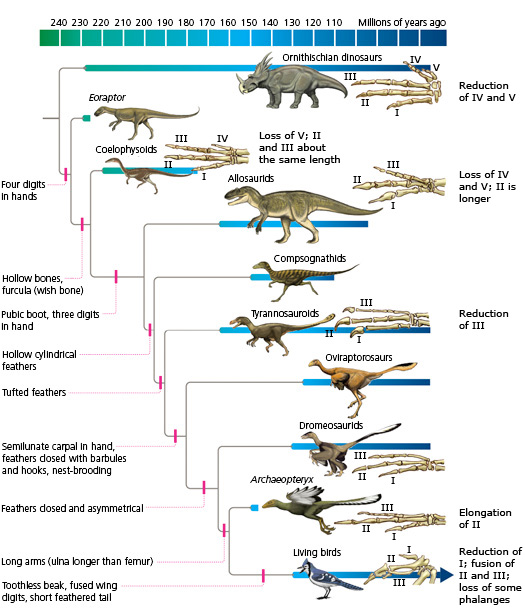
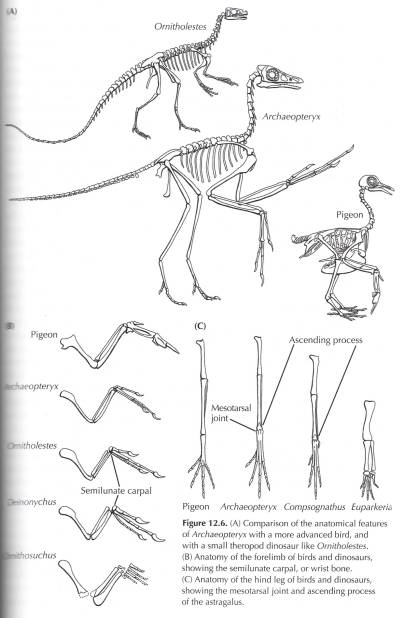
The other thing I wanted to discuss from Origin of Species is how it made me appreciate how much we know now. Let me explain this a bit - right now, there's a lot we don't know about a lot of things in the universe, and it kind of fills you with a longing to know the answers, even though you know you won't survive long enough to learn them. Like life on other planets - I would love to travel to other solar systems and see how complex life has developed on them, what strategies and structures have evolved in an environment completely isolated from our own, but I know that that's something I'll never know. Now, consider Darwin's condition in relation to his theory, having the limited evidence that he did. In the final chapter of Origin, Darwin wrote, "Numerous existing doubtful forms could be named which are probably varieties; but who will pretend that in future ages so many fossil links will be discovered, that naturalists will be able to decide, on the common view, whether or not these doubtful forms are varieties?" We are those "future ages!" Granted, our knowledge of the fossil record is still far from perfect, but we've discovered so many things since Darwin's time. For example, we now have a pretty good idea how whales evolved, how the first tetrapods went from water to land, how birds evolved from dinosaurs, and so many other things that Darwin could only dream of. So, while I'll still long to know the things I can't, I can at least be grateful for the things we know now, that were the longings of people in the past.

Monday, February 12, 2007

Review of Darwin's Origin of Species

There is a follow-up to this review, written after I finished reading the book. However, both of thses entries have been supplanted by a newer post, which combines the two, with a little editing, and a paragraph's worth of new content.

Cover of Origin of SpeciesSince today is Darwin Day, I figured I ought to post something. As it turns out, I'm currently reading The Origin of Species. I'm not quite done with it, yet - only about 2/3 of the way through - but I wasn't intending to write an in-depth review, anyway; I was only going to cover my general impressions of the book. So, with today being the day it is, I figured this would be a good time to do it, as I doubt my opinion will be changed much with the last third of the book.

Long before I picked up the book, I already had a pretty good understanding of evolution - better than most laymen, I'd wager. So I didn't start reading Origin of Species to try to learn anything about the theory. Rather, it was more to do with my interest in history, particularly for this case my interest in the history of science and technology, that was the reason I wanted to read this. And it doesn't disappoint.

Okay, let's get the background out of the way, first. Origin of Species was published in 1859, with the full title, On the Origin of Species By Means of Natural Selection, or, the Preservation of Favoured Races in the Struggle for Life. It's not that Darwin was the first to propose some type of evolution and common descent, but Origin of Species really was the book that presented the evidence in such a way, and proposed a plausible mechanism, that the theory really came to be accepted.

Part of what I find just so fascinating is how Darwin came up with all this without any knowledge of genetics. Even though Gregor Mendel was performing his pea plant experiments around the same time that Darwin wrote Origin of Species, it appears that Darwin wasn't really aware of Mendel's work. In fact, it wasn't until the early 1900's that the scientific community recognized the importance of Mendel's experiments. And it wasn't until the 1940's and 50's that people finally understood what DNA was and how it controlled heredity. Obviously, people in the 1800's knew that offspring bore some resemblance to their parents, but nobody knew how exactly this happened, or what it was that caused offspring to have variations. So Darwin was kind of left groping around in the dark, and all throughout the book, he's reduced to explaining concepts while admitting that he doesn't truly understand the mechanisms responible. From a modern viewpoint, understanding genetics, it almost makes you wish you could travel back and explain it to Darwin. It would have made things so much easier for him.

So knowing that Darwin was ignorant of genetics, and knowing that our knowledge of the geologic record was even less complete then than it is now, it's interesting to see the insights Darwin had that lead him to formulate the theory. For me, when I think of evolution, I think of fossils. Yeah, I know there are multiple other lines of evidence, but growing up, that was the main line of evidence that convinced me that evolution actually happened. But Darwin only briefly discusses fossils in two chapters of the book. The rest of Origin of Species is about what he observed in the world around him - how there seem to be clusters of similar species, the difficulties of distinguishing between true species and merely varieties of the same species, the geographical distribution of species, etc.

It's also interesting how Darwin determined that variation and natural selection were the mechanisms responsible for evolution. Consider one of Darwin's contemporaries, Jean-Baptiste Lamarck. Lamarck came up with the idea of "Use and Disuse," that animals could affect their own bodies through their actions, and that they could then pass on these acquired traits to their offspring. The classic example of this is a giraffe stretching its neck to reach higher leaves, and it's offspring thus having a longer neck because of it. Thanks to genetics, we now know this is a false view. To be fair, Darwin didn't rule this out entirely in Origin of Species, but he concluded that it must have been secondary to variation and natural selection. And one of the best examples he used to demonstrate this was ants - all the variation evident in workers, even though it's the queen that lays eggs.

I also find it fascinating to read Darwin comparing evolution to special creation, to think that creationism was the dominant scientific theory of the time. What I find especially fascinating, is to think how people integrated this into the knowledge of an ancient earth. Darwin fequently cited Charles Lyell in Orign of Species (Charles Lyell was one of the early popularisers of uniformitarianism, and helped promote the idea of the Earth being truly ancient), and in his chapters on the geological record, Darwin discussed some of the different geological periods. And concerning fossils appearing in the geological record, Darwin tells of how people proposed that those species were created during those periods. Just imagine that - seeing all the evidence for an ancient earth, and thinking that different species had been specially created throughout the history of the earth. I suppose without a better explanation, that's all the people could come up with then, but it certainly does seem an odd idea now.

I've read other places that evolution, through Origin of Species, was one of the last major scientific theories that was first presented to the world in a book intended for a lay audience. It wasn't presented in a peer reviewed journal; it wasn't full of technical jargon or equations; it was a book published by a regular publisher and sold through normal venues. It was easy to understand, and became a best seller. Now we need science writers to translate for us lay people, so we're always a few steps removed from the real science. It's hard to imagine any new major theories being presented the same way evolution was in Origin of Species.

I'd recommend this book to anyone with a good understanding of evolution who's interested in the history of the theory, but not necessarily to those people who don't undertand evolution, yet. For one thing, Darwin gets a few things wrong. For another, being written in a style 150 years old, it's not the easiest thing for a modern reader to understand. And finally, genetics is such a huge component of evolution, that a good introduction to evolution should include genetics in its explanation.

Anyway, despite any mistakes he may have made, Darwin certainly made a huge contribution to our understanding of the world. Happy Darwin Day, everybody.

Tuesday, February 06, 2007

Upcoming Darwing Day Event in Wichita Falls

Darwin Day GraphicWhile reading the latest entry on The Loom, I found out that there's actually a holiday called Darwin Day. Following the link that Zimmer provided, I found that there's even an event going on right here in my own hometown of Wichita Falls. Whoda thunk it? I doubt I'll go, but it's nice to see things like that here in this part of Texas.

(Yeah, I stole that picture from Zimmer, but I figured that a caricature from the 1800's was probably in the public domain by now.)

Thursday, August 24, 2006

Knowledge for Knowledge's Sake

This is something I wrote the other day in the comments of a TerrapinTables thread. It's short, but I like it enough that I wanted to post it here on my own blog. It was in response to the following question posed in relation to studying dark matter (prompted by this article), "But tell me this: first, I mean, seriously, aside from knowledge for knowldege's sake, why do we need to know what comprises a galaxy cluster infinity-miles away?" Here is my reply:

First off - I think knowledge for knowledge's sake is a good enough reason to do research. In the same way that some people may find beauty in a painting, others can find beauty in a deeper understanding of the mysteries of our universe. If you're going to question why we need to know about a substance that composes 1/4 of the universe, I could just as easily ask why we have an entire profession dedicated to smearing paint on canvas, or another profession dedicated to plucking guitar strings and beating on drums. (Don't take me the wrong way - I'm not saying the arts aren't worthwhile; I'm saying that I think pure knowledge with no practical applications is just as important.)

But aside from that, who knows where knowledge will lead? Like in the 19th century, when physicists were trying to measure the ether that light travels in, could they have known that it would eventually lead to such practical applications as lasers, CDs and DVDs? Or the geologists of that era, did they really start off thinking that their theories would lead to the abandonment of a literal interpretation of the bible (at least in most of the developed world, not counting the U.S.)?

So there you go - one example of knowledge that led to practical technical applications, and another that had huge societal & cultural implications. I'm sure I could go on listing more, but you get the point.

Friday, July 14, 2006

Physical Comparison of Humans to Animals

Not too long ago, I made a blog entry, Request for Information - Physical Comparison of Humans to Animals I actually did receive some feedback in the form of e-mail, which inspired me to do more research. In the course of which, I found the paper, Differential scaling of locomotor performance in small and large terrestrial mammals, written by Jose (Pepe) Iriarte-Diaz, which was published in the JOURNAL OF EXPERIMENTAL BIOLOGY, 205 (18): 2897-2908 SEP 2002. Anyway, as part of his research into animal locomotion, he had compiled a large set of data of mammal max running speeds along with their body mass and length. This was exactly the type of thing I was looking for in order to characterize how humans compare to other animals.

Continue reading "Physical Comparison of Humans to Animals" »

Wednesday, May 31, 2006

Request for Information- Physical Comparison of Humans to Animals

I'm throwing out a request for information for how humans fare physically in the animal kingdom. If anyone can supply me with links or recommend books on this topic, please do so in the comments. (I don't know how many people will even read this entry, but throwing it out there doesn't hurt.)

Here's where I'm coming from on this. I grew up as a kid who loved watching PBS, and then the Discovery Channel once we got cable. The types of animals that get all the attention are the fastest, the biggest, the strongest, etc.. And these animals are always compared to people, to try to put their skills into perspective. Growing up, I got the impression that humans were pathetic physically, and it was mainly our cleverness that allowed us to be so successful (along with our bipedalism and opposable thumbs). Now, my daughter watches The Most Extreme on Animal Planet, which seems to emphasize this even more.

Recently, there was an article in the 18 November 2004 issue of Nature, titled "Endurance running and the evolution of Homo." There is a very good summary and discussion of this article at the old Pharyngula site. Whether or not endurance running was a major driver of human evolution, I find it very interesting that humans are so good at long distance running, especially after all those years of documentaries telling me how pathetic of runners we are.

Hence, the request for information. Are there any places out there with comparisons similar to the above article, that show how humans fare in the animal kingdom, and not just compared to the biggest/fastest/strongest? If not, where would I go about finding this type of information, so that I could start making my own comparisons.